Sunday, 1 March 2015

1863 Quarantine Regulations for Lyttelton Harbour

Below is a copy of the quarantine regulations for Lyttelton Harbour, Christchurch, New Zealand, as published in the Lyttelton Times dated 5 September 1863.  This was when Camp Bay was the newly appointed quarantine site.  The list of questions for the ship's captain is very interesting!


CAUTION. NOTICE is hereby given that no person will be allowed to board, or quit, any vessel arriving from any port or place beyond the Province until the Quarantine Regulations now in force have been duly complied with. 
The penalties in case of an infringement of the regulations will be most strictly enforced. By order of his Honor the Superintendent, THOS. WM. MAUDE, Provincial Secretary. Provincial Secretary's office, Christchurch, September, 2,1863. 
The following are the regulations now in force 
1. The Master of every vessel arriving at any harbor which shall be deemed by the Harbor Master to be liable to Quarantine shall, on being directed so to do by the Harbor Master, cause the same to be anchored in the Quarantine ground appointed for the Harbor, or forfeit and pay for every such offence the sum of one hundred pounds. 
2. The Master of every vessel so anchored shall neither himself quit, nor permit any seaman, passenger, or other person to quit the same until he shall have been duly admitted to pratique, or forfeit the sum of one hundred pounds. 
3. Every seaman, passenger, or other person so quitting shall, for even such offence, forfeit the sum of twenty pounds. 
4. Every vessel so anchored is to hoist a yellow flag, of not less than six breadths of bunting, at the main by day, and a light by night in a lantern such as is used in her Majesty's Navy, and to keep the same respectively hoisted until released from Quarantine, or forfeit the sum of twenty pounds. 
5. The Master of every vessel so anchored is to deliver to the Harbor Master or other authorised person his bill of health, manifest, log-book, and journal; and he is to All up a report in the manner pointed out in the Schedule A annexed. 
6. The Master of every vessel so anchored who shall suffer any goods, wares, or merchandize, packets, books, letters, or other articles to be unshipped or landed, and any person or persons who shall be concerned in the unshipping or landing of the same, shall forfeit for each and every article so unshipped or landed the sum of twenty pounds. 
7. Every person or persons who shall knowingly receive any goods, wares, or merchandize, packets, package, baggage, books, or letters, or any other article whatever from-any vessel so anchored shall forfeit for each and every article the sum pounds. 
8. Any person going within the limits of any Quarantine Station when any vessels shall be there at anchor performing Quarantine shall forfeit any sum not exceeding twenty pounds. 
9. If any officer or person entrusted with orders respecting Quarantine shall in any way neglect his duty, he shall forfeit for such offence the sum of twenty pounds. 
10. The Harbor Master shall immediately after his having so anchored any vessel, report the same to the" Resident Magistrate and Health Officer, or to the person or persons acting or appointed to act for those functionaries. 
11. The Resident Magistrate and Health Officer or Medical Practitioner to be appointed from time to time for that purpose by the Resident Magistrate, shall, upon the receipt of such report, visit the vessel so anchored, and if they shall find that any sickness of an infectious or contagious nature exists, or shall have then recently existed on board of her, they shall submit the information to a Board, consisting of the Resident Magistrate, one or more Justices of the Peace, the superior Officer of the Customs of the Port, the Health Officer, or Medical Practitioner as aforesaid, and one or more legally qualified Medical Practitioners nominated for this purpose by the Resident Magistrate, such Board to be convened by the Resident Magistrate, which Board, or the majority of them, shall have authority to detain such vessel in Quarantine until every symptom of the aforesaid disease shall have disappeared, and until sufficient time to prevent the spread of such disease shall, in the opinion of the Board, have elapsed since the last case disappeared, when the same Board, or the majority of them, have hereby power to release such vessel from Quarantine and admit her to pratique. 
12. During the period any vessel may be in Quarantine, the Resident Magistrate and Health Officer shall visit her alongside from time to time and institute such regulations as the nature of the case may demand, and the Master or Commander shall carry such regulations into effect, or forfeit a sum not exceeding twenty pounds. 
POWER TO RESIDENT MAGISTRATE IN CERTAIN CASES. The Resident Magistrate at any port for which no Harbor Master is appointed shall have all such powers as are hereinbefore given to Harbor Masters. All penalties hereby imposed shall be recoverable in a summary way. 
SCHEDULE A. Questions required to be answered by the Master or other person in command of any ship or vessel arriving in the Port of Lyttelton from any infected place. 
1. What is the tonnage of the vessel and her name? —Answer. 
2. What is the Master's name, and are you the Master?— Answer. 
3. From whence do you come, and when did you sail?— Answer. 
4. At what port have you touched on your passage?— Answer. 
5. What vessel have you had intercourse or communication with on your passage, and from whence did they come? —Answer. 
6. Have you any, and what bills of health? Answer. 
7. Did the cholera or any other highly infectious and dangerous disease prevail at the place from which you sailed, or at any of the places at which you have touched, or on board of any vessel with which you have had communication; if so, state when and where?— Answer. 
8. In the course of your voyage have any persona on board suffered from sickness of any kind? What was the nature of such sickness, and when did it prevail? How many persons were affected by it, and have any of them died in the course of the voyage?—-Answer. 
9. What number of Officers, Mariners and Passengers have you on board?— Answer. 
10. What was the number of persons on hoard your vessel when you sailed?— Answer. 
11. What is the whole number of persons now ill on board your vessel?— Answer. 
12. If there be no sickness now on board, when did the last attack of disease appear, and when did it entirely disappear?—-Answer.

Friday, 12 December 2014

Putting a Mistake Right!


So far, touch wood, I have had only a couple of mistakes in my books on immigrant ships.  Mistakes are terrible when published in print and I always get a sinking feeling when I learn of them.  In my book on the ship Lancashire Witch I have made a mistake of epic proportions and need to put it right somewhere.  I'm using my blog to correct it.

The 1867 journey of the Lancashire Witch included four prostitutes of the lowest grade and Eliza Trumper, "far gone in family way," as was written on an official document in the archives.  Click here to view the document.

Now one could presume that Eliza had been lumped in with the "prostitutes," or rather, a few women who caused a bit of trouble or had slightly lower morals than the majority on that ship.  I'm pretty sure now that Eliza did no wrong.

While researching the book I traced the baby that Eliza had in Christchurch and followed him to Hastings.  This research was correct.  Eliza then seemed to disappear from the records apart from a marriage for an Eliza Trumper that seemed to match exactly.  Age, place of birth, area of marriage etc all matched.  I presumed this was the same Eliza as she didn't have a common name and this was in the early days of Christchurch when there weren't that many people and you could easily track a person's movements.  Well haven't I learnt a lesson.  A relation has since contacted me and said that this wasn't the correct Eliza.  I was wrong.

Eliza Trumper had a cousin by marriage named Eliza Trumper!  So there were two Eliza Trumpers in Christchurch at a similar time.

So what actually happened to the Eliza Trumper on the ship Lancashire Witch?  She was a good girl and was already married, her maiden named being Williams.  She was travelling out to New Zealand to meet her husband James Trumper, who had travelled out earlier.  This was common practice as often the family couldn't afford to all come out at the same time and relations were sent for or waited for the opportunity to get a free passage (like Eliza).   Why did Eliza end up on the official list with the prostitutes?  I have a couple of theories which I will never be able to prove or disprove.

  1. Did Eliza withhold the fact she was pregnant and had a husband in NZ?  This would not have gone down well as the colony was after single women domestic servants and they gave free passage to these women.  Once married or pregnant, a woman often stopped working and being useful to the Provincial Government.  Eliza suddenly became useless to the colony.
  2. Did they suspect Eliza was unmarried and pregnant?  They often didn't believe young women who said they were "meeting their husband" in the colony.  Maybe she got treated very unfairly.    

Eliza and her husband only had the one child.  They apparently moved back to England at some stage but Eliza's death can not be found by family members. What happened to her is a mystery?

The other Eliza Trumper married Samuel Derbidge and had a large family.  She was a completely different lady, who came out to New Zealand on the ship Huntress.

Ok, I feel better now for putting right a wrong.

Friday, 21 November 2014

Sepia Saturday 255: Handcrafts

Well I don't know any silhouette artists like the picture for this weeks Sepia Saturday, but my great great grandmother, Mary, was into handcrafts such as embroidery.  So I'm posting a photo of her with some other ladies who also look like they were into embroidery and other crafts.


From left to right:  Jessie Susan Wright nee Harris and two children, unknown girl, Mary Lord nee Meng and likely her daughter Elise May Lord (known as May), unknown child and woman.

This photo was most likely taken in Ohoka, as Jessie and Mary lived in Ohoka at this time (around 1898).  The unknown girl of about age sixteen has a black band around her white sleeve, indicating that a family member has recently died.

The woman on the right who is unnamed, has some close relationship to Mary as she is in a family wedding photo that I own.  I have no idea who she is however!  Very frustrating.

I like the way the photo is set up.  It is casual but has a sheepskin on the ground for the children to sit on and a couple of cushions, also a rug I think, to add a tiny bit of luxury.  Behind are what look like some hollyhocks and climbers going up a fence.  Where the photo was taken exactly, I have no idea, but it was likely in Ohoka in someones back garden.  I like the way the babies in the photo have gone blurry as they wouldn't sit still long enough to capture their wee faces correctly.  So they are still a blur over 100 years later.

The Harris and Meng families must have been very close and were friends their whole lives.  Mary and the Harris girls would have gone to Ohoka School together in the 1870s.  I can imagine them as young Mums getting together to do their craft work and have a cup of tea occasionally!

We still have many pieces of craft work done by Mary.  I'm guessing she probably did the dress on May Lord who is sitting on her lap.

Thursday, 13 November 2014

Sepia Saturday 254: Couples on the water

I'm writing again about my grandparents and their adventures on the water. My Pop, Grant, who was known as Jack, owned a boat which he took out fishing etc. My Grandma Doreen was a keen fisherwoman also. The photo from this weeks Sepia Saturday of a couple crossing a river, reminded me of one I have taken on Lake Forsyth on what appears to be a leisure trip in about the 1960s.


The hill behind the clinching couple on the Sepia Saturday website, looks a bit like the hill in the following photo.  But that is where the likeness ends.  Most of us Kiwi women get our feet wet.  Out of necessity and the willingness to get dirty and try anything.  My Grandma obviously had to get out and push the boat as well.  Many hands make light work.  NZ women are not scared of a bit of dirty cold water.  She is in a lovely dress that she would have sewn herself (Grandma was a dressmaker).  And she has a scarf on her head.  It looks fairly windy as her dress is blowing against her legs. 


This lake sits between Birdlings Flat, a stark and wonderful stoney beach with wild waves and extreme weather conditions, and Little River, a very small town which sometimes turns in to a river during flooding events. It is a great wee community and a lot of artists and alternative lifestyle people live there. Lake Forsyth these days is quite full of algal blooms and general disgustingness due to it being often land locked and the effluent from surrounding cow farms flowing into it. Too much nitrogen, perfect for algae to grow! My Grandma said that in the past they used to open up the sea entrance to the lake to let the fresh seawater in, but this is not always done these days. I wasn't sure why, but have just read on wikipedia that these attempts at opening up the lake didn't improve the water quality very much. I went sailing on this lake once and was warned not to fall in as I would end up with some sort of gastro bug or poisoning from algae. Anyway back to the fishing couple. Here is another photo of that day but with more people in the boat and a small boy onshore.


I don't know who the extra people are in the boat and can't really recognise them.  The boy on shore could have been my Uncle Bill, but I can't see enough of him.

I have taken photos of this lake with amazing reflections and have also painted this scene, so know every crack and line well. It is a fascinating, yet very polluted lake.

Saturday, 8 November 2014

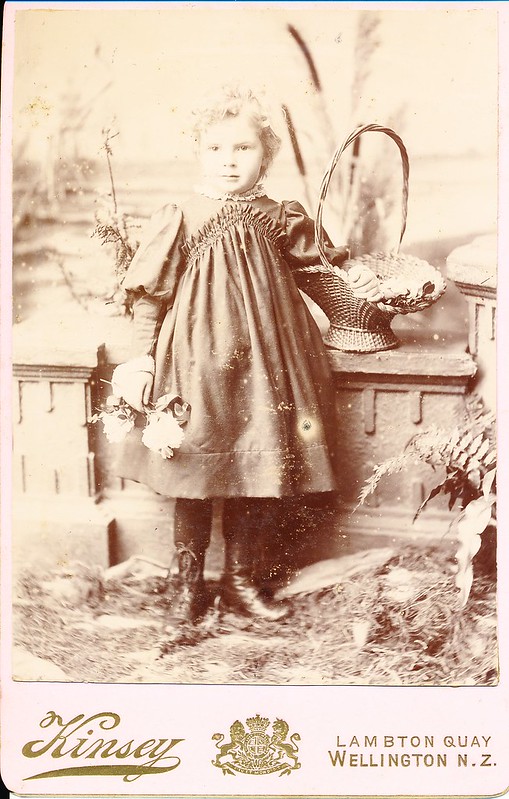
Dora Agnes Jenkins - a lovely photo

I often mention about my wonderful collection of old photos and how I can't name many of them as no one has written on the backs of them. Well the other day I decided to research one of the few photos that was actually written on. The name on the back said "Dora Agnes Jenkins" aged 4, July/15 1893. This photo was taken in Wellington and is now 121 years old. Amazing when you think about how old it is.


Dora Agnes Jenkins
I had no idea who Dora was so started doing some research. I found that she was born in 1887 to Francis John and Sarah Oram Jenkins. Who they were, I had no idea. I then found out that Dora never married in her lifetime and died in 1963 aged 77. This made me want to find out more about her. She probably had no children and therefore no grandchildren or great grandchildren to remember her when she was gone. And there is probably no one else researching her except me. It is quite sad really.

I tried to find when the family had arrived in NZ and found them on the ship Hereford in 1879 arriving into Canterbury with the following family members listed:

Francis J. Jenkins aged 33 of Middlesex, compositor
Sarah Jenkins aged 28
Frank M. J. aged 7
Melville A. F. aged 4
Beatrice aged 1

They also had more children in New Zealand, Arthur Edwin, 1881, Charles Alexander in 1883, Alfred Oram in 1885 and Thomas William, 1893.

I'm guessing this family got to know my family somehow through being neighbours or going to the same church, so I searched some more.  I couldn't find any obvious links.  I couldn't find the history of the family in Christchurch and I am pretty sure they were not related to my family.  The photo was taken in Wellington, so it is assumed the family lived there, not in Christchurch.

I found out that her father passed away in 1905 of a workplace accident at the Government Printing Office.  Dora's mother Sarah had received some compensation but wanted more.  She would have been struggling to survive.  Sarah remarried in 1909 to Mr. Rees Watkins of Petone. Dora Jenkins wore a pretty dress of white muslin and was one of the bridesmaids. She would have been 22 at the time and probably quite lovely.

Dora though never married and I can't find anything else about her.  Hopefully she had a good life.  She was a dear little girl in the photo!


Monday, 3 November 2014

Sepia Saturday 253: Angling and fishermen

My Pop was a keen fisherman.  I'm posting this very special picture of him fishing at the mouth of the Kaiapoi River where it feeds into the Waimakariri River, Canterbury, New Zealand.  His name was Grant but everyone called him Jack instead for some strange reason.  He was a watersider, so took loads off ships.  He did his back in hooking great big loads and carrying them on his poor back.  He was also a Kiwi joker - pranks, nicknames for people and general craziness.


On the day of this photo in 1947, he was trying to catch salmon whilst standing on a Waimak Flattie, a kind of flat boat which was commonly used on this large braided river to get around.  He is using an old fashioned cane fishing rod.  Did he have success that day?  No, not according to my Grandma.

My Grandma was sitting on the bank embroidering.  She was with her parents.  Grant was her boyfriend.  I'm guessing my photographic great grandfather Arthur Cyril Pearce took this photo.  My Grandma carried this photo around with her, showing everyone her new boyfriend.  The photo became creased and worn out.  We found it in one of her old albums and she was surprised to find it.  I had never seen it before and instantly loved it.  I took it home and took out the creases with photoshop. 


As I was doing the repair work on the photo, I noticed how young my Pop was.  He still had the lankiness of youth, but quite muscley arms from all the labouring type work he did.  He also had a baby face.  His tongue is hanging out in concentration as he casts out.

In the distance you can see other boats, other anglers trying their luck in the Waimakariri.  Grant is casting towards Stewart's Gully which is a little bunch of cottages and holiday homes where my Grandma used to go for holidays and where she first met Grant. 


My grandparents fished all their lives, catching many fish and having many adventures and lovely experiences in nature.  My Pop died very young, in his 50s.  I knew him until I was about five years old, so can't remember him very well.  At his funeral everyone laughed when they saw a sticker on the back of his car which read, "Old fishermen don't die, they just smell bad."

Saturday, 1 November 2014

Sepia Saturday 252: An Anniversary for the Ohoka School

In 1937 it was the Diamond Jubilee for the Flaxton-Ohoka School.  I don't have any pictures of the event but I do have a menu and schedule of events for the evening. 

The function was held at the Wetheral Grain Store, a building which I'm guessing doesn't exist anymore. I wonder how fancy this place was or whether it was just a big shed? Wetheral is a teeny place between Kaiapoi and Ohoka.  It was held on 20 October 1937 at 6.30pm.  I'm guessing my Great Grandma Dorothy Pearce nee Lord would have attended this since she attended the Ohoka school many years before. 

The menu is interesting.  It was called a "banquet" and consisted of ham, tongue, corned beef, salad and bread.  As well as savouries, cakes, pastry, fruit salad, trifle and cream.  The drinks consisted of tea, coffee and soft drinks.  No booze at this party!

People mentioned in the schedule of events included Rev. H. Cottom who said grace.  M. Holton and Mrs S. L. Orchard who helped to cut the Jubilee Cake.  Toasts were made to Parliament, the education board, ex-pupils, school teachers past and present, the school committee past and present, the ladies and the newpapers.  People involved included Mr. Mayer, Williams, Banks, Spencer, Steele,  Wright, Knight, Newnham, Heald, Martyn, Ivory, Orchard and Mrs Ostler and Miss Parkin.

The brochure was printed by Kaiapoi Record Print and there was a space on the back for autographs but my Great Grandma got none that night and her programme was left blank. 

Does anyone else have old menus in their photo collections?