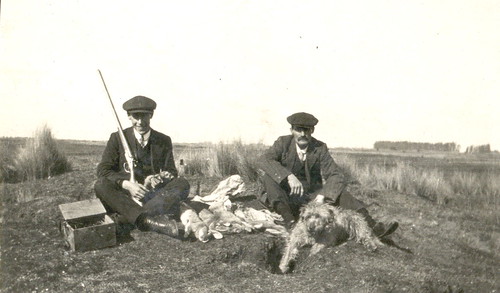
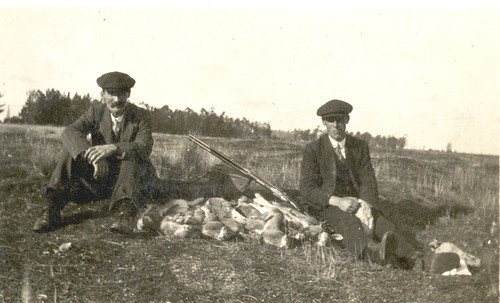
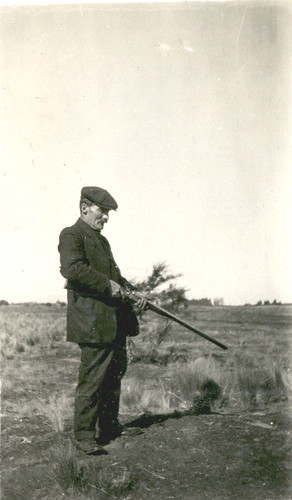
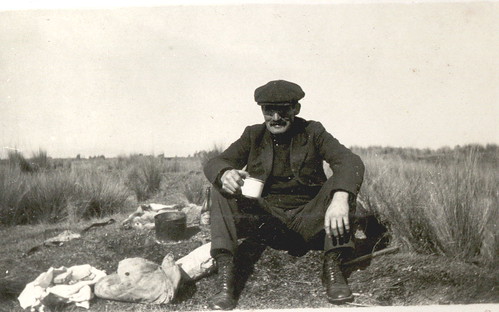
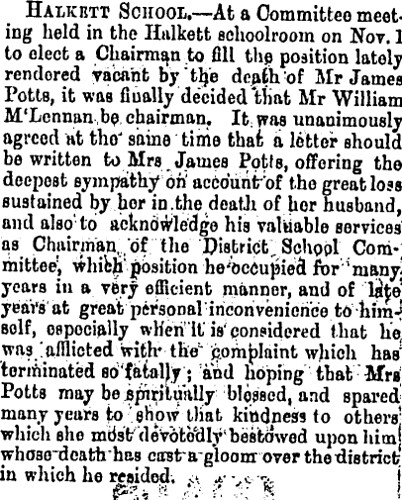
The following is the article from the Press dated 08-12-1871 is about the Mayor of Christchurch along with Councillors visiting the No. 2 embankment of the Waimakariri River to see the work that had been done there to protect Christchurch from floods. It mentions James Potts the Surveyor. It talks about what his house and grounds look like, his wife Sarah Potts and what the area in general looked like in 1871. It also mentions a ebony black clock that was presented to him. This is still in the family today.
WAIMAKARIRI PROTECTIVE WORKS.
At has
long been a matter for regret that ratepayers of Christchurch, who contribute towards the erection and maintenance of these works on the
Waimakariri, which have been carried out under the supervision tthe Board
of Conservators, have-or at least a very large majority of them—not the slightest conception either of the magnitude and importance of the labors of
the Board or the great difficulties, natural and otherwise, under which they
were carried out. Even the members of the City Council, through
whose agency the rate is collected, were until yesterday, with the
exception of His Worship the Mayor, who is ex officio a member of the Board,
totally unacquainted with the works, or the importance as affecting the
interest of Christchurch, of their being maintained and extended so far
as the means at the disposal of the Board will admit.
The ratepayers, of course,
have often indulged in the good old British privilege of a grumble, and
are very prone to say that a great deal of money has been spent for
very little purpose, but a visit to the works will very soon dispel all
such ideas, and the Board will, in that case, receive that meed of
praise which their strenuous efforts fully entitle them to. It must be
recollected that they have had to cope with a river not only formidable
in itself, but also requiring a special training in order to enable
this to be done satisfactorily and completely; as the usual experience of
most engineers are quite at fault, and it is only by a close and
attentive study to the ever varying and changing threatenings of the
river, that a knowledge of how best to deal with it has been attained.
This has cheerfully been given to it by the Board, ably supported by
their engineer, and the consequence is that what might have proved
almost irretrievable ruin to Christchnrch, has been happily arrested,
and humanly speaking the river has been confined within safe limits.
Therefore it is, and taking into consideration these facts, that we say
the Board of Conservators deserve the highest possible amount of credit from the public generally for their efforts.
Yesterday, however by
invitation of his Worship the Mayor, tbe City Council paid a visit to
the Waimakariri. Shortly after 8 a.m., a four-horse drag, tooled by Mr
E. W. Millett, was in readiness at the City Council Chambers, and the
party, which included his Worship the Mayor, Councillors Sawtell, Hart,
Pratt, Joues, Hobbs, Bishop, and Calvert, the Town Clerk (Mr G. Gordon),
Mr Fisher, one of the conservators, and the representatives of the
local journals. Having responded to the call of "all aboard," a start was
made. The half-way house, Taylor's Yaldhurst hotel, was quickly
reached, and after a short halt a fresh departure was taken, and away we
bowled across the stony plains and river beds for the house of the
Surveyor. Mr J. Potts, which is
situated on the West Coast road, about sixteen miles from town, and
about two from the embankment which it was proposed to visit, and
which is known as No. 2 embankment, which has recently been finished
since the July flood.
On arriving at the bouse, we were met by Mr R. J.
S. Harman, chairman of the Board of Conservators, who, with Mr Fisher
and Mr Tosswill, enacted the part of guide for the day. After a short
halt for refreshment, the commissarist department being under the able
superintendence of Mr Gordon, we girded up our loins for a four or five
mile walk over boulders and sand, which under the scorching rays of
yesterday's sun was far from being the most agreeable part of the
programme. However, Mr Harman was inexorable, and we resigned ourselves
to our fate, and placed ourselves unreservedly under his guidance.
Before proceeding to notice the various points which came under our
inspection, we will first notice wbat has been done at what may be
called the homestead of the Board, viz., the ground in and around the
Surveyor's residence, which is now in course of being ploughed up
preparatory to being used as a nursery for the young trees used in tbe
protective works. The cottage of the Surveyor has also been painted
and the grounds neatly fenced, altogether presenting a trim appearance.
Bidding adieu to the hospitable cottage of Mr Potts,
we proceed to visit the first embankment in our immediate vicinity, the
order of route having been changed in order to allow of our guide
showing us the embankment first erected by the Government before the
Board of Conservators was called into existence.
The country over which
we had to pass to reach the embankment, showed evident signs of having
been at one time the bed of a river, the numerous channels worn by the
scour of the water, and the high banks showing this most conclusively.
It mainly consists of rolling downs, gradually descending in gradient
until the bed of the river is reached. About half-a-mile from the
cottage, we come upon what is known as the Halswell river bed, which so
closely joins in with what is known as the Christchurch channel of the
Waimakariri as to give grounds for alarm in case of fresh. Here and
there are to be seen the marks of the overflow, in the shape of debris and deposits of silt, &c., which amply prove the terrible nature of
the enemy with which the Board has to cope, an area of nearly three
miles having been at one time inundated. As we wend our way across the
plains, we catch sight of the embankment, which we are first about to
visit, and which was erected by the Government after the February flood
of 1868. It is composed of shingle topped witls gorse plants, and has
been considerably added to and strengthened by the Board since they have
been in office, and is now used by them as a means of repressing the water which may find its way down the Christchurch channel and passing
it on to the northern side. As we draw nearer we get a good view of it,
and find it to be simply a mound of shingle some sixteen or seventeen
feet high and twelve chains or so in length. Passing through a wire
fence which has been placed by the Board to prevent the sheep nibbling
the young trees in the plantation, we arrive, after a contest with
several gigantic boulders, in which we came off but second best, at the
commencement of the work. At this point we missed two or three of our
companions, and on looking out over the plain we saw them comfortably
ensconced under the lee of a sandhill, with a white pocket handkerchief
displayed as a signal to halt, they having—cute fellows as they were
—kept close company with the worthy Town Clerk, who was more than once
suspected of having a small flask somewhere in reserve. But our guide,
the chairman of the Board, was adamant, so after waving a mournful
farewell, we proceeded on our weary pilgrimage over what one of the
party facetiously .termed "petrified kidneys."
The direction in
which the embankment runs, is about north-east, its northern end
trending somewhat easterly on reaching the channel. On the western face
the Board has planted two rows of trees close together, the outer line
being the line which they consider should have been taken by the
embankment, being nearly due north and south, and running at nearly
right angles with the inner line. These trees are the Black Lombardy
Poplar, and are growing remarkably well, the shoots looking very healthy
and showing signs of vigorous vitality, notwithstanding that the soil
in which they are planted is so very unpromising. The willows planted
too, are looking well. Proceeding along this embankment we notice many
marks of the recent floods in the debris left, but at the same time
it is to be noticed that this seems to settle down and form, as it were,
a new soil, so that in time it is to be hoped that the silting up thus
going on will materially strengthen the defence against the water offered by the shingle embankment. At the end of the embankment, the
Government had made a cutting through a sandhill, but this has now being
turned to account by the Board by facing it with large stones, built so
as to offer little or no resistance to the water, but to shunt it off
to the northward. The embankment then takes a turn to the eastward, and
after a short but sharp penance among the boulders we reach the celebrated cage upon which and its vicinity the river spent the whole of
its strength during the great flood. Here the Board had a hard fight with the
enemy. Solid concrete blocks and masses of concrete bags were placed in
here, but the scour of the river was so great that immense holes were washed under concrete blocks and they fell in. Here the value of the works
executed by the Board was strikingly apparent. The river which at one time threatened
to burst over all obstacles, and which made such havoc in the defences
opposed to it, has been turned quite in another direction, and the
channel is at some distance from this point.
Descending from the
embankment, we come to a perfect miniature forest of trees planted by
the Board, which have grown up very thickly, and form an admirable
defence. A short rest of a few moments is all that is permitted to us by
the indefatigable Chairman, and we are once more en route, this time
over an interminable plain of boulders. We cast longing glances in the
direction of the haven of refuge in which our truant companions have
taken shelter, and where they are quietly enjoying a pipe, but it's no
use, stern duty urges us on. and "onward" is the cry. In the distance
looms the object of our visit, embankment No. 2; but alas, between us
aud it lies a thickly strewn boulder plain. However, as the Scottish
proverb has it we "set a stout heart to a stiff brae," and get on very
well considering.
At short intervals wherever it has been deemed
necessary from the contour of the bank, willow groins, that is
plantations of willows about two feet high, thickly planted, have been
made, the angle at which they are planted being such as to accommodate
rather than obstruct the run of water, but to shunt it off towards the
northern bank. These groins are growing very rapidly and will shortly
form a most effectual defence against the incursion of the water, should
it succeed in passing the No 2 embankment. Here we pause for a moment
to see the effect of the work of the Board. Their object has been to
erect defences and turn off the river, planting as fast as possible
behind such defence, so as to offer every resistance to the water, and
thus as it were winning foot by foot the disputed territory. This is
being done over the whole of this portion of the river bed, and the
plantations are also being carried up on to the higher ground, so as to
prevent any water finding its way by that route.
Arrived at the
embankment, we find our missing friends, much refreshed by their halt,
awaiting us, and we proceed to inspect what is justly looked upon by the
Board as its greatest triumph. This embankment is composed of shingle,
as in the case of the first referred to, and is about thirteen chains
long from what may be called the shore end to the extreme point jutting
out into the river. Before proceeding to notice in detail the present
appearance of the embankment it may be interesting to trace as well as
we can the various aspects of the river since March of this year. In
that month the main stream was confined by a groin jutting out a short
distance above the No. 2 embankment, faced with boulders, and the No. 2
embankment itself, also faced with boulders. Before the flood of July,
1871, two lines of boxes made somewhat in the shape of an inverted V,
but filled with gravel, and thus presenting a sloping surface to the
river, thereby assisting the run of the water without making a scour,
were placed near the end of No. 2 embankment, the ends having a slightly
northward tendency, and being faced with boulders as before. After tbe
flood of July, 1871, the position was as follows :—the upper groin
still held, but there was a great scour against the face, and this being
across the old channel, fears were entertained of its holding. It did,
however, but not so the No. 2; the boulder end and the boxes were swept
away, the latter being left on a sort of island, and the water made a
clean breach through, the whole weight and force of the stream falling
as we have already said upon the cage, and the concrete blocks, which
only just stood the untoward pressure. On September 5, the boulder face
of the upper groin began to wear away very fast, the stream impinging
very strongly upon it. The Board then resolved, with regard to the
breach made through No. 2 embankment to adopt another course, and a line
of boxes, nineteen in number, each weighing twenty-five tons, protected
by a breastwork of bags of concrete, at intervals, jutting out, and
faced at the end with 800 bags of concrete, and a T shaped face of six
boxes jutted out into the stream, thus driving the stream against a
small island which intervened between the work and the main stream, and gradually directing the water northwards, while this was being done
the water got through in the old channel at the upper defence, and on
October 4, eight boxes were placed on the outer face and three on the
inner of this work, together with two detached boxes lower down, which
had the effect of throwing the water over on to the opposite or northern
bank. But in the meanwhile water was coming down the old channel and
impinging on the No. 2 embankment at the shore end. It was therefore
determined to run out a line of boxes. 2 1/2 chains in length, and four
detached boxes in the line of the stream still further in shore, which,
together with a small line of boxes immediately above the bags at the
commencement of the boxes first put down, had the effect of silting up
the stream and making it comparatively slack water, so that the danger
was averted. We are indebted to a series of drawings excellently
executed by Mr J. N. Tosswill of the various phases of the river for
the above information.
These boxes we may say are about
fourteen feet wide at the bottom, holding some twenty-five tons of
gravel, and are placed with their sloping faces outward so that the
centre of gravity is well back. Having inspected this work, which
certainly will amply repay a visit, we next proceeded to look at upper
groin referred to. At this corner there is a bend of the river, and the
current is making into the bank. With a view of preventing this a line
of boxes have been built in shoreward, which will be continued across on
to the high ground if it is found to be necessary. It may be here
stated that the river is gradually eating away the northern bank, and in
all probability will, if followed up and defences erected as the works
are advanced, finally scour out that channel sufficiently for the surplus
water. Just below the work are two or three detached boxes, which it is
intended to extend as they are found to answer admirably.
The
work of inspection over, we adjourned to the cover of a friendly
sandhill, where a capital luncheon was laid out, and all our past
pilgrimages were forgotten in the enjoyment of the well-earned rest.
Luncheon over, Cr Hart, ever on the alert for speechifying, proposed the
health of the Board of Conservators, coupled with the name of the
chairman, Mr R. J. S. Harman, expressing the great gratification and
surprise felt by the members of the City Council, at inspecting the
works carried on under the supervision of the Board, and their hope that
the work might last and prove as successful as it deserved. This toast
having been drunk in champagne with the usual honors, Mr Harman
responded, pointing out the very great difficulties under which the
Board had labored in carrying out their work, and assuring the Mayor and
Councillors of the very great pleasure the Conservators felt at their
visit, and hoping that more of the citizens might be induced to come up
and see for themselves, what had been done. Again the caeoethes loquendi
attacked Councillor Hart, and from the shady side of the sandhill he
proposed the health of the Mayor, the founder of the feast. This of
coarse was drunk in bumpers, and one gentleman actually chanted musical
honors —an attempt which, much to our delight, failed most signally. The
signal was then given for the return, and after a rather wearisome
march across the plains, we assembled in Mr Potts' cottage once more.
On our arrival there it was evident from the unfathomable mystery
depicted in the countenance of our worthy Town Clerk that something was about to
happen,and this mystery was heightened when that gentleman a
la Heller produced a very handsome clock from some unknown receptacle.
It then leaked out that the Board of Conservators, in recognition of
the very able manner in which Mr Potts, their Surveyor, had discharged his very onerous duties, and also as a mark of their sense of the hospitality of Mrs Potts,
exercised on the occasion of the visits of the Board to the works, had
determined on making a presentation to them. We soon formed ourselves
into the orthodox meeting, and with a small stock of "sparkling" in
reserve, the ceremony commenced.
Mr Harman said that the; Board had determined upon presenting a testimonial to Mr and Mrs Potts,
as a slight acknowledgment of the hospitality so freely offered to the
Board, and also as a mark their appreciation of the manner in which
Mr Potts had discharged the very onerous duties of his office . During the time Mr Potts
had been in the service of the Board he had always discharged the
duties in the most satisfactory manner, and while the Board were
desirous of acknowledging Mrs Potts' hospitality, they were most anxious to testify to them their appreciation of the zeal with which Mr Potts
had discharged the duties devolving upon him. He had been constant in
his watch for danger—danger which in many instances threatened life and
property, and had spared neither time nor trouble to carry out the very
onerous duties devolving upon him. He had much pleasure in handing Mr
and Mrs Potts, on behalf of the
Board of Conservators, the small token of their appreciation. He would
read the inscription on the clock which was as folows—"James Potts,
from the Board of Conservators, South Waimakariri District, 1871," and
he hoped they would long preserve it as a memento of the confidence of
the Board in them. [Cheers.]
His Worship the Mayor, in a few
appropriate, remarks, concurred with all that had fallen from Mr Harman
with respect to the manner in which Mr Potts had discharged his duties, and also the kindly hospitality evinced by Mrs Potts, and concluded by wishing them long life aud happiness.
The toast having been heartily responded to, Mr Potts replied in a few well chosen words, and the ceremony terminated.
The clock was a very elegant ebony one, having in the front a silver plate bearing the inscription referred to.
The horses were then put to, and in response to Mr Millett's "all
aboard," we took our seats and came into town shortly after seven
o'clock, having spent a most agreeable day.
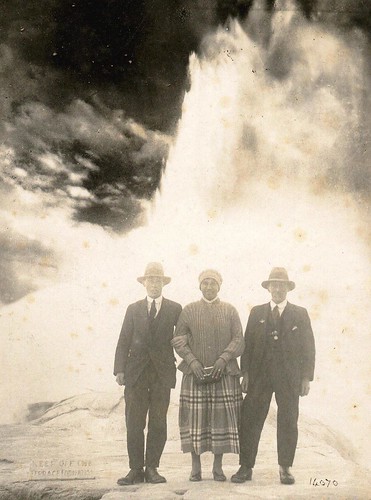
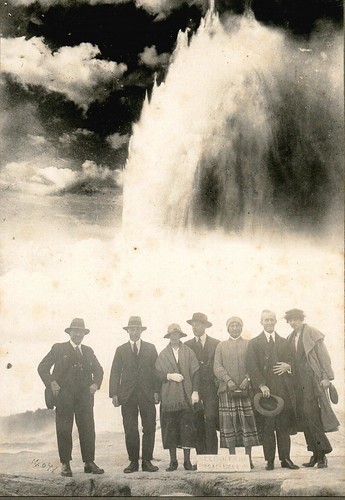
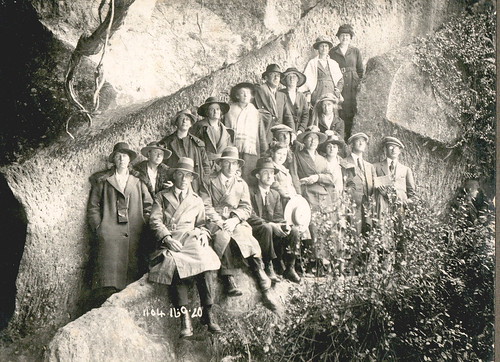 Waitomo Caves? Not sure about this. Cyril and Willy are sitting in the front in trench coats.